One-minute introduction
Every now and then, there’s a situation where I need to briefly introduce myself, academically. This can be with or without any visual support (i.e a slide). Instead of doing so semi-randomly, I though I would prepare such a one-minute introduction, once an for all. So here I go, with a single illustrative hex-sticker slide.
-
I am Laurent Gatto, (now full) professor of bioinformatics at the UCLouvain. I teach (more of my courses) at the Faculty of pharmacy and biomedical sciences and run a computation biology lab at the de Duve institute.
-
The lab’s research focuses on developing statistical and machine learning methods to process, explore and comprehend high-dimensional biological data, such as typically produces by omics technologies. Working on the university biomedical campus, we deploy our work on clinically and biomedically relevant research projects, in collaboration with other laboratories on the campus.
-
I am committed to the open, transparent and rigorous practice of scientific enquiry. In particular, we make every possible effort to make our research repeatable, reproducible and replicable.
-
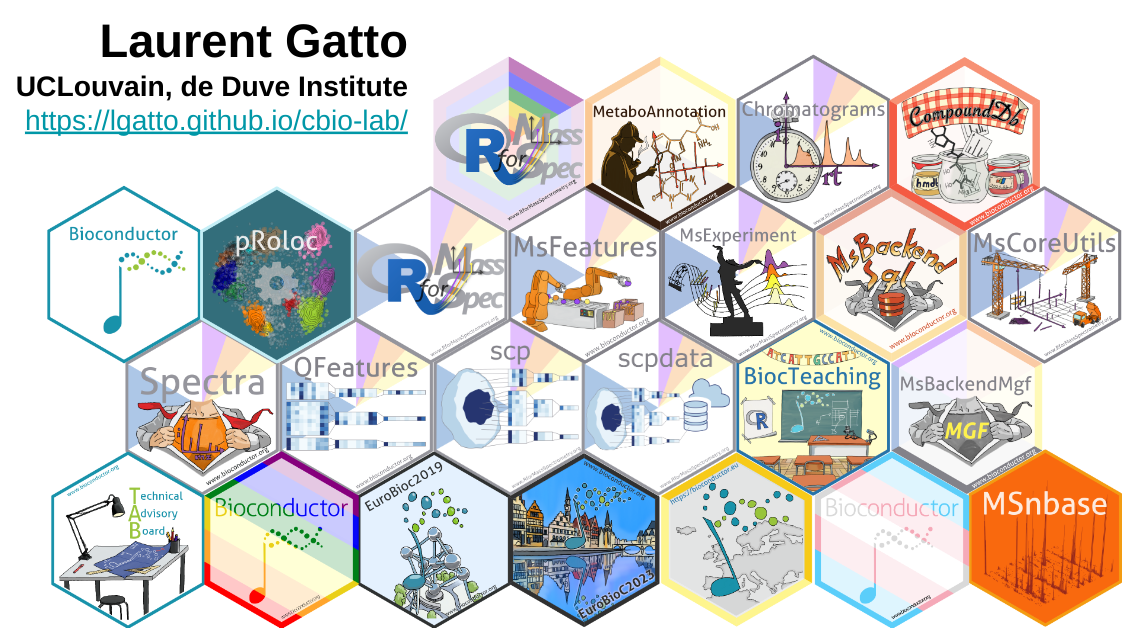
The development and publication of scientific software (see here, here and here) is an integral part of my work and is reflected by my contributions to the Bioconductor project. Some specific examples include spatial proteomics data analysis with pRoloc, single-cell proteomics with scp and mass spectrometry data processing with the R for Mass Spectrometry packages.
-
I also serve on the Bioconductor technical, and community advisory boards, European Bioconductor Society, education and teaching committee (chair from its creation to March 2026) and the Code of conduct committee (until 2023), and co-organise the yearly European EuroBioc conference.
Some information above was updated in Feb 2026.
Update (2026-02-10): I was recently asked to provide a short intro for an invited talk:
Laurent enjoys to type on keyboards, especially on mechanical keyboards to write code to analyse data, write software, or customise the behaviour of his favourite editor. Not so much to write boring emails. He likes to do science, but only when that science is open. He would argue that if the science is closed, it might not be called science. He has spend a considerable time analysing different kinds of omics data and writing research software and has somehow stumbled into his current position as a full Professor of bioinformatics at the UCLouvain. (Full of what?). He’s considering whether the next step in his career should be hiding into a cave or be the first human to get a one-way ticket to a distant planet and study extraterrestrial caves.
